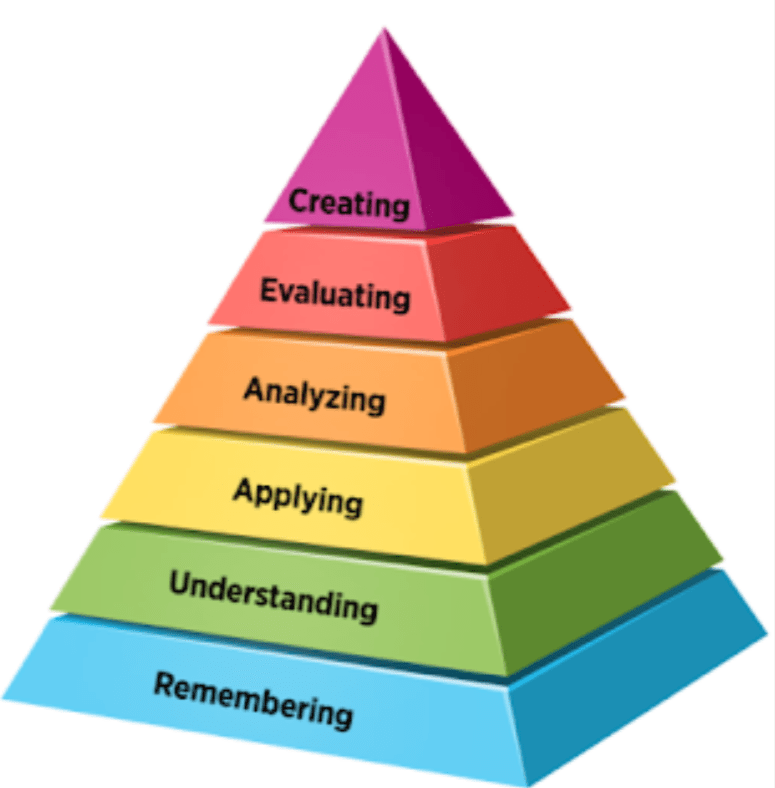
Bloom’s taxonomy is a framework for categorizing educational objectives based on the level of cognitive skills required to achieve them. Benjamin Bloom and his associates came up with the original idea in 1956, and Lorin Anderson and David Krathwohl revised it in 2001. Bloom’s taxonomy consists of six categories, from the lowest to the highest level of cognitive complexity:
- Remember: The ability to recall or recognise factual information, such as definitions, terms, dates, etc. For example, a student who can remember the names and dates of the presidents of the United States has achieved this level of learning.
- Understand The ability to explain, interpret, summarise, or paraphrase the meaning of information, such as concepts, principles, procedures, etc. For example, a student who can explain the main idea of a text or the steps of a scientific method has achieved this level of learning.
- Apply The ability to use learned information in new or familiar situations, such as solving problems, performing tasks, demonstrating skills, etc. For example, a student who can apply the Pythagorean theorem to find the length of a side of a right triangle has achieved this level of learning.
- Analyse The ability to break down information into its parts and examine their relationships, such as identifying causes and effects, comparing and contrasting, categorising, etc. For example, a student who can analyse the strengths and weaknesses of an argument or the similarities and differences between two genres has achieved this level of learning.
- Evaluate The ability to judge the quality, value, or significance of information, such as making decisions, giving feedback, critiquing arguments, etc. For example, a student who can evaluate the credibility of a source or the validity of a conclusion has achieved this level of learning.
- Create The ability to generate new or original ideas, products, or solutions based on existing information, such as designing, inventing, composing, synthesising, etc. For example, a student who can create a new product based on market research or a new poem based on a theme has achieved this level of learning.
Educators and researchers frequently use Bloom’s taxonomy to develop curricula, assessments, and learning activities that promote higher-order thinking skills and more profound learning outcomes. It can also help learners monitor their progress and set goals for their learning. According to Bloom’s taxonomy, higher levels of learning require more cognitive effort and are more meaningful and transferable than lower levels of learning. Therefore, it is essential to challenge learners to move beyond remembering and understanding information to applying, analyzing, evaluating, and creating new knowledge.
You can read about Online English Language Learning Resources in the following post:
Anderson and Krathwohl Model
In 2001, Lorin Anderson and David Krathwohl revised the taxonomy to make it more relevant and applicable to the 21st century. They made two significant changes. They changed the nouns to verbs to emphasise the dynamic and active nature of learning. For example, knowledge became remembered, comprehension became understood, and synthesis became created. They swapped the order of the two highest levels so that evaluation came before creation. They argued that this reflects the cognitive processes of producing original work, which require critical and creative thinking.
They revised the taxonomy to address some of the limitations and criticisms of the original version. The original taxonomy was based on the assumption that knowledge is hierarchical and linear, which does not account for the interconnectedness and complexity of modern knowledge domains. The original taxonomy was too rigid and prescriptive, implying only one correct way to approach learning and thinking. The original taxonomy was required to capture the diversity and variability of cognitive processes and outcomes across different disciplines, contexts, and learners. The original taxonomy needed to reflect the current research and understanding of how people learn, especially concerning metacognition, motivation, and affect.
By revising the taxonomy, Anderson and Krathwohl aimed to create a more flexible and dynamic tool that can accommodate different perspectives and purposes of learning. They also wanted to update the terminology and examples to make them more consistent with contemporary educational practices and standards.
The revised version of Bloom’s Taxonomy is shown below:
| Level | Definition | Example Verbs |
|---|---|---|
| Remember | Recall facts and basic concepts | Define, list, name, recall, recognize |
| Understand | Explain ideas or concepts | Classify, describe, explain, identify, summarise |
| Apply | Use information in new situations | Apply, demonstrate, perform, solve, use |
| Analyze | Break down information into parts and examine relationships | Compare, contrast, differentiate, distinguish, relate |
| Evaluate | Make judgments based on criteria and standards | Appraise, argue, assess, critique, justify |
| Create | Produce new or original work | Compose, design, develop, invent, produce |
Application of Taxonomy in Teaching Practice
Educators can use the updated Bloom’s Taxonomy as a guide for designing learning objectives, activities, and assessments that align with the desired level of cognitive complexity. It can also help learners monitor their progress and self-regulate their learning strategies. By using the revised Bloom’s Taxonomy, educators and learners can enhance the quality and effectiveness of teaching and learning in any subject area.
One of the ways that teachers can use the updated version of Bloom’s Taxonomy in their classroom teaching practice is to design activities and assessments that align with the different levels of cognitive skills. For example, teachers can use the following verbs to guide their planning and instruction:
- Remember: recall, recognise, list, label, name, define, describe
- Understand: explain, summarise, paraphrase, illustrate, classify, compare, interpret
- Apply: use, demonstrate, solve, calculate, perform, implement
- Analyse: compare, contrast, differentiate, organise, relate, examine, question
- Evaluate: judge, critique, justify, argue, defend, appraise
- Create: design, invent, produce, construct, compose, synthesise
By using these verbs, teachers can ensure that they address the different levels of cognitive complexity and provide students with opportunities to develop higher-order thinking skills. For instance, teachers can ask students to recall the main points of a lesson (remember), explain them in their own words (understand), use them to solve a problem or a case study (apply), compare and contrast them with other concepts or perspectives (analyse), evaluate their strengths and weaknesses or their relevance and validity (evaluate), and create a new product or a project based on them (create).
Additionally, teachers can use Bloom’s Taxonomy to differentiate instruction and assessment according to the student’s readiness, interest and learning preferences. For example, teachers can offer students choices of activities and assessments that vary in complexity and challenge. Some examples of activities are:
- Remember: create a quiz or a crossword puzzle based on the lesson content
- Understand: write a summary or a blog post about what you learned
- Apply: use a simulation or a game to practice your skills
- Analyse: create a concept map or a Venn diagram to show the relationships among concepts
- Evaluate: write a review or a critique of a book or a movie related to the topic
- Create: design a poster or a video to present your ideas or solutions
These activities can be designed to suit the interests and preferences of the students. For example, some students may prefer to work individually or in groups; some may like writing or speaking, and some may prefer using visuals or sounds. Teachers can also provide students different levels of support and guidance depending on their readiness. For example, some students may need more scaffolding or feedback than others.
Teachers can also use Bloom’s Taxonomy to monitor and evaluate students’ progress and provide specific and constructive feedback. Using Bloom’s Taxonomy as a reference point, teachers can evaluate students’ performance to determine their strengths and shortcomings and give feedback that aligns with the learning objectives. For example, teachers can praise students for demonstrating higher-order thinking skills, such as analysis or evaluation and suggest ways to improve their lower-order thinking skills, such as recall or understanding. Teachers can also use Bloom’s Taxonomy to set goals for student’s future learning and encourage them to move up the levels of cognitive complexity.
In conclusion, the updated version of Bloom’s Taxonomy by Anderson and Krathwohl is a valuable tool that teachers can use to create and conduct great lessons that meet the needs and expectations of 21st-century learners. Teachers can foster students’ cognitive development and enhance learning outcomes using Bloom’s Taxonomy in their classroom teaching practice.




 Mind Over Matter
Leave a comment